Merck and KingMed to Jointly Advance Precision Medicine for Colorectal Cancer treatment
July 8, 2019
- Merck and KingMed Diagnostics enter into strategic partnership to jointly advance genetic testing for the diagnosis and treatment of colorectal cancer in Chinese hospitals, helping hospitals optimize biomarkers (including RAS/BRAF) testing process to provide individualized treatment.
- The two companies will work closely to provide accurate and reliable testing technology, advance the standardization of the testing process of colorectal cancer biomarkers (including RAS/BRAF), shorten the testing results turnaround time and reduce testing costs.
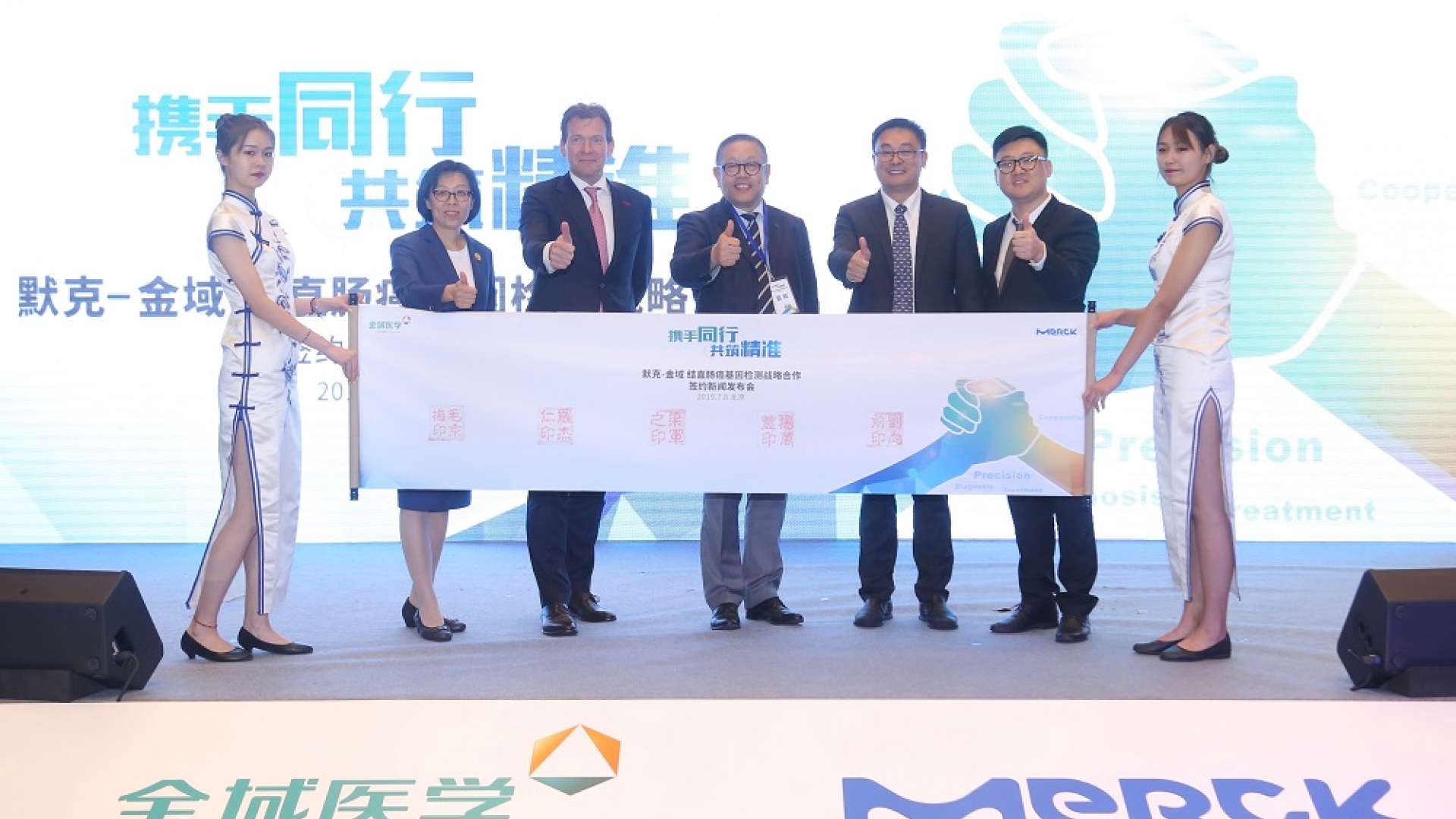
Beijing, China, July 8, 2019 – Merck, a global leading science and technology company, and KingMed Diagnostics, a leading Chinese medical testing and diagnostics company, signed a strategic cooperation agreement on colorectal cancer genetic testing today. According to the agreement, the two sides will focus on accurate testing and precision treatment of colorectal cancer in China, aiming to jointly advance the standardization of the molecular marker testing process for colorectal cancer to help provide optimal treatments.
“Merck is committed to developing and delivering innovative and high-quality therapies and medications that address patients’ unmet medical needs,” said Rogier Janssens, Managing Director and General Manager of Merck’s Biopharma business in China. “Colorectal cancer is one of the most deadly cancers plaguing patients in China. We believe that accurate diagnose together with precision medicine can help doctors optimize treatments to prolong patients’ lives. Our vision is to improve the lives of 40 million Chinese patients by 2025. Through collaborating with KingMed Diagnostics, Merck aims to promote precision medicine for colorectal cancer and the formulation of standardized treatment guidelines.”
“KingMed Diagnostics has always placed the clinical needs of patients and doctors first,” said Yang Wanfeng, deputy general manager of KingMed Diagnostics. “Our collaboration with Merck is built on our extensive and well-established testing system and network, transportation and logistics system, state-of-art reference laboratories and highly-professional academic teams. Our two companies will work closely to provide accurate and reliable testing technology, raise genetic testing capability, and help standardize the testing process for colorectal cancer biomarkers (including RAS/BRAF), shortening the turnaround time of testing results and reducing the testing cost, benefitting more patients with advanced CRC in China.”
In recent years, the prevalence of colorectal cancer has continued to rise in China. In 2015, the number of new colorectal cancer cases was 376,300, and the number of colorectal cancer deaths was 191,000, according to China Cancer Statistics. In 2018, colorectal cancer was the third most common cancer, second only to lung cancer and gastric cancer. CRC is difficult to identify in the early stages where progression is very slow and the symptoms are often latent and easily be confused with other diseases. As a result, patients often overlook such symptoms and are not diagnosed until reaching the middle and late stages, which pose major challenges for treatment.
“As the Chinese saying goes, ‘A key will only unlock the door it is designed for,’” said Liang Jun, vice president of Peking University International Cancer Hospital and the director of the hospital’s Oncology Center. “Precision medicine optimizes CRC treatment for each patient, bringing greater clinical benefits to patients with advanced and metastatic colorectal cancer. Improving the survival rate of CRC patients should be the top priority in clinics. As colorectal cancer has entered the era of precision treatment, genetic testing technology can provide valuable guidance for doctors choosing the drug that is most suitable for the patient and help the clinic to develop a precise treatment plan.”
In recent years, a number of anticancer drugs have been included into the NRDL, and the Chinese government has waived the customs duties on imported anticancer drugs. However, there still exists a significant gap between China and Europe and North America with respect to genetic testing. Numerous experts have called for genetic testing to be included in the NDRL, joining anti-cancer drugs, to improve the affordability of genetic testing and achieve precision treatment for more cancer patients.
The 2018 Expert Consensus on Molecular Biomarkers Testing for Colorectal Cancer recommended genetic testing for biomarkers of colorectal cancer (including RAS/BRAF) be performed on patients with confirmed diagnosis of recurrent or metastatic CRC to help predict the effectiveness of drug treatment and disease prognosis.
However, such testing is performed on only about 20-30% of patients with colorectal cancer in China, and the testing rate is especially low in tier two and tier three cities as well as underdeveloped areas. As a result, accurate diagnosis and personalized treatment options are unavailable to many CRC patients. Many doctors lack an adequate understanding of the importance of molecular marker testing. At the same time, there are also great discrepancies among methods and procedures for gene testing, resulting in long testing cycles and high testing costs. Many hospitals in China have not yet been able to establish a molecular pathology testing platform and must rely on third-party agencies to carry out genetic testing.
“The number of new cancer patients in China is increasing year by year,” said Vivian Mao, VP and head of Medical Affairs at Merck. “Inspired by the philosophy of ‘As One for Patients’,Merck has been accelerating our R&D innovation for oncology drugs to help more cancer patients enjoy longer lives. In 2015, the Merck Medical Department established the Biomarker Science Liaison (BSL) team dedicated to the promotion of precision testing and precision treatment of colorectal cancer. The BSL team is working closely with many stakeholders to promote the standardization of molecular markers testing process for colorectal cancer. Together with KingMed, Merck will establish a regional academic platform to promote a greater understanding of genetic testing among healthcare providers and optimize the testing process for colorectal cancer.”
About Merck
Merck, a leading science and technology company, operates across healthcare, life science and performance materials. Around 52,000 employees work to make a positive difference to millions of people’s lives every day by creating more joyful and sustainable ways to live. From advancing gene editing technologies and discovering unique ways to treat the most challenging diseases to enabling the intelligence of devices – Merck is everywhere. In 2018, Merck generated sales of €14.8 billion in 66 countries.
Scientific exploration and responsible entrepreneurship have been key to Merck’s technological and scientific advances. This is how Merck has thrived since its founding in 1668. The founding family remains the majority owner of the publicly listed company. Merck holds the global rights to the “Merck” name and brand. The only exceptions are the United States and Canada, where the business sectors operate as EMD Serono in healthcare, MilliporeSigma in life science, and EMD Performance Materials.
.jpg)