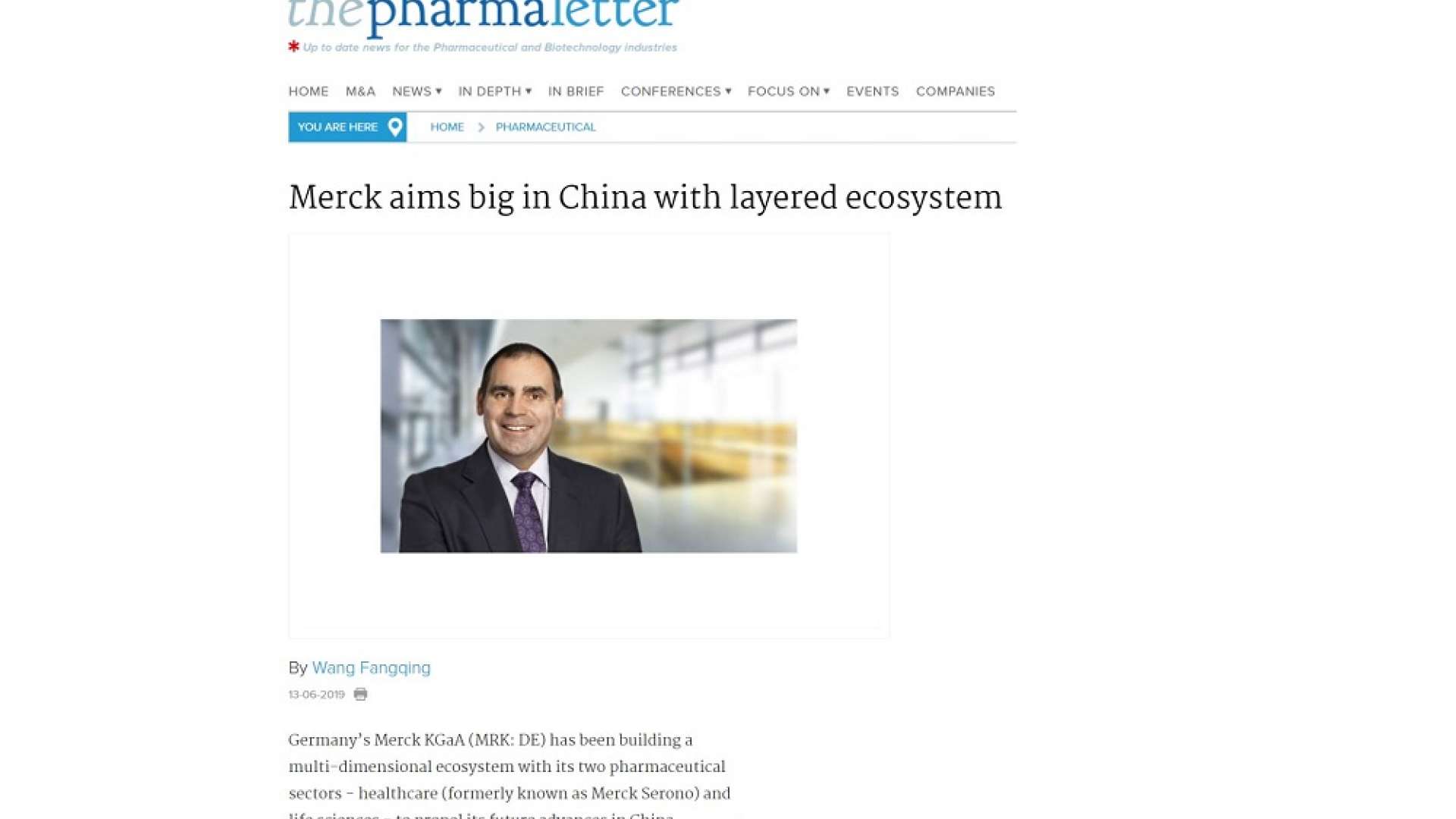
《The Pharma Letter》专访:构建多维生态体系 默克在中国展宏图
默克在中国拥有巨大的机遇,这已不是秘密。近日,默克生命科学工艺解决方案全球负责人Andrew Bulpin博士与默克中国生物制药业务董事总经理罗杰仁接受了英国知名媒体《The Pharma Letter》的采访,就默克在中国制药行业的重点领域并如何在中国驱动业务的长远发展分享了见解。
来源 | 作者:《The Pharma Letter》 | Fangqing Wang
***Please Scroll down to view English Version***
访默克生命科学工艺解决方案全球负责人Andrew Bulpin博士、默克中国生物制药业务董事总经理罗杰仁
默克在中国拥有巨大的机遇,这已不是什么秘密。近日,默克生命科学工艺解决方案全球负责人Andrew Bulpin博士与默克中国生物制药业务董事总经理罗杰仁Rogier Janssens接受了英国知名媒体《The Pharma Letter》的采访,就默克在中国制药行业的重点领域并如何在中国驱动业务的长远发展分享了见解。
默克正通过其三大业务中的两大与制药行业紧密相连的业务领域 – 医药健康和生命科学,逐步构建起一个多维的生态系统,以驱动其在中国的长远发展。
新型疗法
默克在北京的研发中心成立于2009年,负责为中国带来新的治疗方法。默克目前在中国销售17种针对多种疾病的药物,包括治疗转移性结直肠癌的爱必妥®(西妥昔单抗)、辅助生殖的果纳芬®(促卵泡素α),以及治疗2型糖尿病的格华止®(二甲双胍)。
默克中国生物制药业务董事总经理罗杰仁在接受英国知名媒体《The Pharma Letter》记者王芳青采访时表示:“北京研发中心是我们在全球研发业务网络中的一个重要枢纽,我们在这里为中国市场研发高质量的创新药物。我们关注中国尚未满足的医疗需求,主要是肿瘤学、免疫肿瘤学、免疫学等方面的医疗需求。”
最近,默克研发了一种新型免疫疗法:靶向PD-L1和TGF-β的双功能融合蛋白M7824 (bintrafusp alfa)。默克表示,公司正与葛兰素史克(LSE:GSK)合作,谋求共同发展,默克正在美国、欧洲和包括中国的亚洲招募非小细胞肺癌和胆管癌患者进行临床试验。
北京研发中心还致力于Avelumab和Tepotinib的研发,前者是一种用于治疗实体瘤的抗PD-L1抗体,后者是一种治疗非小细胞肺癌和肝细胞癌的cMet抑制剂。
Avelumab正在招募非小细胞肺癌和头颈癌患者,作为药品全球三期研究的一部分。
罗杰仁表示:“我们致力于在驱动创新、深耕中国,向中国患者提供高质量的药物。”
像其他跨国制药公司一样,默克也希望从中国最近的药品审批流程改革中获益。今年4月,中国国家药品监督管理局(NMPA)接受了爱必妥®的适应症扩展申请,增加用于治疗复发性或转移性头颈部鳞状细胞癌。考虑到爱必妥®目前的适应症,爱必妥®已于2018年10月被列入中国国家医保目录(NRDL)来治疗转移性结直肠癌。
罗杰仁表示:“中国一直致力于医疗改革,对此我们深受鼓舞,预计我们将会看到中国国家医保目录更加频繁地更新,能够更好地满足有医疗需求的患者。”
中国正在拟定一个新的国家医保目录调整计划,希望通过更频繁地更新,及时增加市场急需药品。
与中国生物科技行业共发展
默克的生命科学业务为全球研发实验室和生产外包企业(MOs)提供广泛产品和解决方案,伴随着生物技术产业的蓬勃发展,中国拥有大量的生物技术初创企业,默克在中国有巨大的机遇。
“我们看到,我们在中国的业务随着市场增长而扩张,”默克生命科学业务全球工艺解决方案负责人Andrew Bulpin博士表示。在过去10年中,中国充满活力的制药行业发生的迅猛变化,给他留下了深刻印象。中国正从一个仿制药大国转变为细胞疗法和基因疗法等生物技术的创新中心。”
Bulpin博士表示:“这确实是一个巨大的趋势,我们必须在中国持续投资,确保我们满足市场持续增长的需求。”
默克近年来投资约2.5亿欧元(约合2.805亿美元),在江苏省南通市投建两家工厂:一家专注于医药健康业务领域,另一家专注于生命科学业务领域。2018年9月,公司开始在无锡设立一次性技术产品生产基地,为当地客户提供灵活定制的解决方案,加速药物开发和商业化生产。该工厂将于2019年投入使用。
默克还就不同议题与中国监管机构密切合作。例如,我们与中国国家药品监督管理局(NMPA)合作协助药监部门GMP检查员培训项目,了解生物制药工艺及GMP检查要点,共同为除菌过滤及无菌工艺模拟等生物制药工艺流程制定准则。
“中国渴望学习新技术,正因为他们知道创新是目前中国发展的重点。”Bulpin博士表示。他还预测,中国将很快成为某些领域的全球领导者。
Bulpin博士以CAR-T疗法为例。根据中国国家药品监督管理局称,至少有十几种CAR-T疗法正在进行临床研究,其中大多数针对CD19,而且该国正在考虑允许医院自制CAR-T疗法。“中国比西方国家有更大的灵活性来更快地修订这一进程。我们很容易看到中国在未来10到15年内成为全球领导者之一。”
此外,他表示,中国正在朝着实施知识产权保护的正确方向迈进,特别是在今年3月颁布《中华人民共和国外商投资法》之后。
“默克在全球拥有5500个商标,因此使我们的技术和品牌得到保护非常重要。”Bulpin博士表示。
请点击这里阅读原文。
Germany’s Merck KGaA (MRK: DE) has been building a multi-dimensional ecosystem with its two pharmaceutical sectors – healthcare (formerly known as Merck Serono) and life sciences – to propel its future advances in China.
Novel therapies
Merck’s R&D center in Beijing, built in 2009, is responsible for bringing new treatments to China where Merck is currently selling 17 drugs targeting multiple diseases, including Erbitux (cetuximab) for metastatic colorectal cancer, Gonal-f (follitropin alfa) to assist reproduction, and the type 2 diabetes treatment Glucophage (metformin).
“The Beijing hub is a key hub in our global network where we develop high quality, innovative drugs for the China market. We focus on unmet medical needs in China, primarily oncology, immune-oncology and immunology,” said Rogier Janssens, general manager at Merck Biopharma in China, speaking to The Market Letter’s local correspondent Wang Fangqing.
A recent example is Merck’s novel immunotherapy asset, the bifunctional fusion protein M7824 (bintrafusp alfa) that targets PDL1 and TGF beta. Partnering with GlaxoSmithKline (LSE: GSK) for joint development, Merck is recruiting in the USA, Europe and Asia, including China, for non-small cell lung cancer (NSCLC) and biliary tract cancer, according to the company.
The Beijing center also contributes to the development of the anti PDL1 solid tumor treatment avelumab, as well as tepotinib, a cMet inhibitor that treats non-small cell lung cancer (NSCLC) and hepatocellular cancer.
Avelumab is recruiting patients with NSCLC and head and neck cancer as part of the global phase III studies.
“We are dedicated to innovate in China, for China and providing quality drugs directly to Chinese patients,” said Mr Janssens.
Like other multinational pharmas, Merck also expects to benefit from China’s recent reforms in drug approval processes. In April, China’s National Medical Products Administration (NMPA) accepted Erbitux for its NDA filing to treat relapse and metastatic squamous head and neck cancer. The monoclonal antibody (MAb) was already included in China’s national reimbursement drug list (NRDL) for its current indication in Oct 2018.
“We are encouraged by China’s commitment to healthcare reform, and we are expected to see more frequent renewal of the NRDL to create better access for patients in need of medicine,” Mr Janssens said.
China is in the process of establishing a new NDRL adjustment scheme to allow more frequent updates to add needed drugs in time.
Growing with China’s biotechs
Merck’s life science business, supplying global R&D labs and contract manufacturing organizations (CMOs), sees great opportunities in China, which is home to a large number of biotech startups along with a booming biotech industry.
“We see our business in China expanding in line with market growth,” said Andrew Bulpin, head of process solutions. He was impressed by the fast changes in China’s dynamic pharma industry in the past decade, which saw a generics country turn into a hub for biotech innovations such as cell therapy and gene therapy.
“It really is coming on enormously and we have to continue to invest in China to make sure we are well positioned,” Dr Bulpin said.
Merck invested about 250 million euros ($280.5 million) in recent years to build two facilities in Nantong, Jiangsu province: one for the healthcare sector and one for the life science sector. In September 2018, it started construction of a facility in Wuxi to provide flexible and customized single-use solutions to support local customers in accelerating drug development and manufacturing. The facility is expected to be operational in 2019.
Merck also works closely with Chinese regulatory authorities on different matters. For example, it collaborated with the NMPA to develop guidelines for bioprocesses including filtration and simulation. It also helped the NMPA train GMP inspectors so that they know if a biotech facility is run properly.
“The Chinese authorities are eager to learn new technologies because they know innovation is the key focus right now in China,” Dr Bulpin said. He predicted that China could be a global leader in certain areas very soon.
He took CAR-T therapy as an example. At least a dozen of CAR-T therapies, most of which target CD19, are in clinical studies, according to the NMPA, and the country is considering allowing hospitals-made CAR-T therapies.
“China has much more flexibility to modify the process quicker than western countries. I can easily see China become a global leader over the next 10 to 15 years,” Dr Bulpin said.
He continued that China is moving towards the right direction to enforce IP protection, especially under the foreign investment law issued in March.
“Merck has 5,500 trademark families globally, so it’s very important to us to protect the technologies and brands we have,” he said.
Please click here to read more.